Community Ties: Jamie Strong
Jamie Strong, routesetter and co-owner of Zenith Climbing Center, shares a wealth of climbing advice with Beta for Being. She covers everything from how to get stronger faster, to why climbers shouldn’t take grades too seriously. Follow Jamie on Instagram at @theoneincatears.
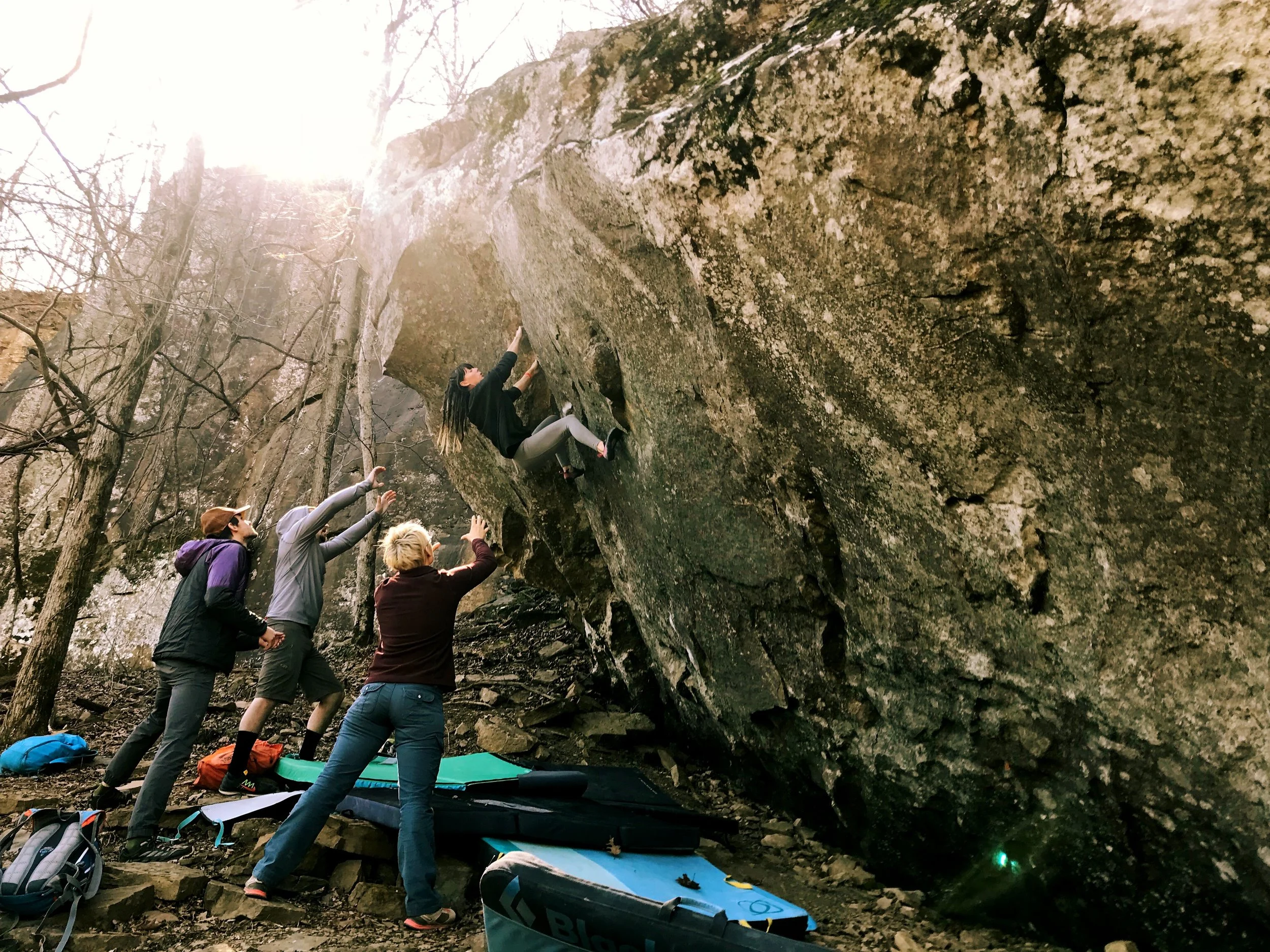
Amanda: When did you start climbing, and how old were you?
Jamie: I was 29, about to turn 30 when I started climbing.
Amanda: Why did you start climbing?
Jamie: I was at a point in life where a lot was changing, and I was looking for something new to throw myself into. I grew up with a pretty strong athletic and gymnastics background, so movement-based sports always clicked for me.
I’d climbed recreationally a couple of times before and remembered how fun and different it felt. Around that time, my sister and brother-in-law were climbing regularly, so they invited me to come with them.
At first I mostly just tagged along and flailed my way up the wall, but I got hooked pretty quickly. There was something about the mix of problem solving, movement, and constant progression that pulled me in right away.
Amanda: Speaking of, what made climbing “stick” for you?
Jamie: I think there were two big things that made climbing stick for me. One was practical, and one was harder to explain.
On the practical side, I committed early. I bought the harness, shoes, chalk bag, and workout clothes. Basically everything I needed right away. Part of that was just wanting to remove barriers and make it easy to keep showing up, but part of it was probably a little intentional “sunk cost” psychology too. Once I had invested in it, it felt more real and I was more motivated to stick with it.
The other part was the sport itself. Climbing felt completely different from any other athletic experience I’d had. Even with my gymnastics and sports background, I’d never done something that combined physical effort and problem solving in quite the same way.
Every route asked something different of you: strength, balance, coordination, patience, creativity, sometimes all at once. It was a full-body and full-brain experience, and I never really felt bored doing it.
That constant challenge and variety is probably what hooked me the most.
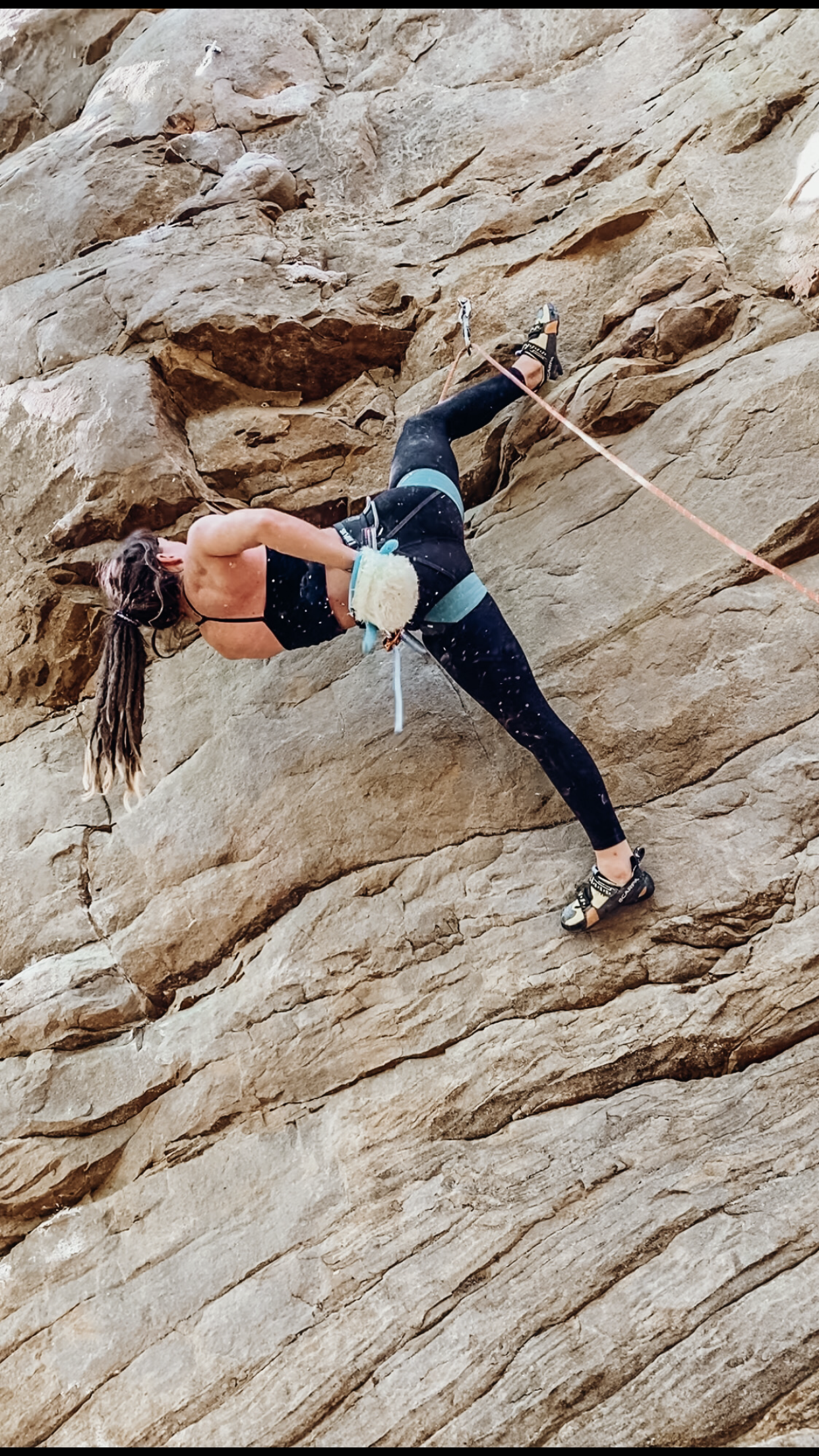
Amanda: Which climbing disciplines are you most drawn to?
Jamie: I’m honestly drawn pretty equally to both bouldering and sport climbing. Usually my focus shifts depending on the season and whatever goals I have at the time. Right now I’m training for a bouldering competition, so most of my energy is going toward bouldering, but there are other times of the year where sport climbing becomes the priority.
What I’ve come to believe, though, is that the two disciplines really complement each other. Bouldering builds power, movement, and problem solving in a really direct way, while sport climbing develops endurance, pacing, and mental composure over longer efforts. When I spend too much time only doing one, I can usually feel the gaps pretty quickly.
Even beyond performance, I think there’s value in experiencing both. Most climbers are trying to push themselves in some way, whether that’s grades, confidence, movement, or just staying engaged with the sport long term.
Having both disciplines in the mix keeps climbing feeling balanced and keeps me progressing in ways I probably wouldn’t if I only stuck to one lane.
Amanda: What is one thing new climbers overlook that would help them improve faster?
Jamie: One of the biggest things new climbers overlook is the value of climbing around people who are more experienced than they are.
You learn so much just by watching how stronger climbers move, approach problems, rest, project, and think through sequences. A lot of the nuances of climbing are hard to teach directly, but they start to sink in naturally when you’re consistently around people who have been doing it longer.
I’d also say newer climbers improve faster when they expose themselves to a lot of different styles instead of only climbing what feels comfortable or suits their strengths. Try slab, overhangs, compression, coordination moves, technical vert climbing.
Early on, variety builds a much broader foundation than hyper-focusing on grades or a single style. Thoughtfully seeking out anti-styles is important. Gym bros need to get on the slab wall! :-)
And honestly, I think people worry about getting stronger too soon. Strength matters eventually, but in the beginning, just climbing a lot is usually the best thing you can do. Most newer climbers are held back more by movement efficiency, body positioning, and experience than by raw strength. Time on the wall solves a surprising amount of that.
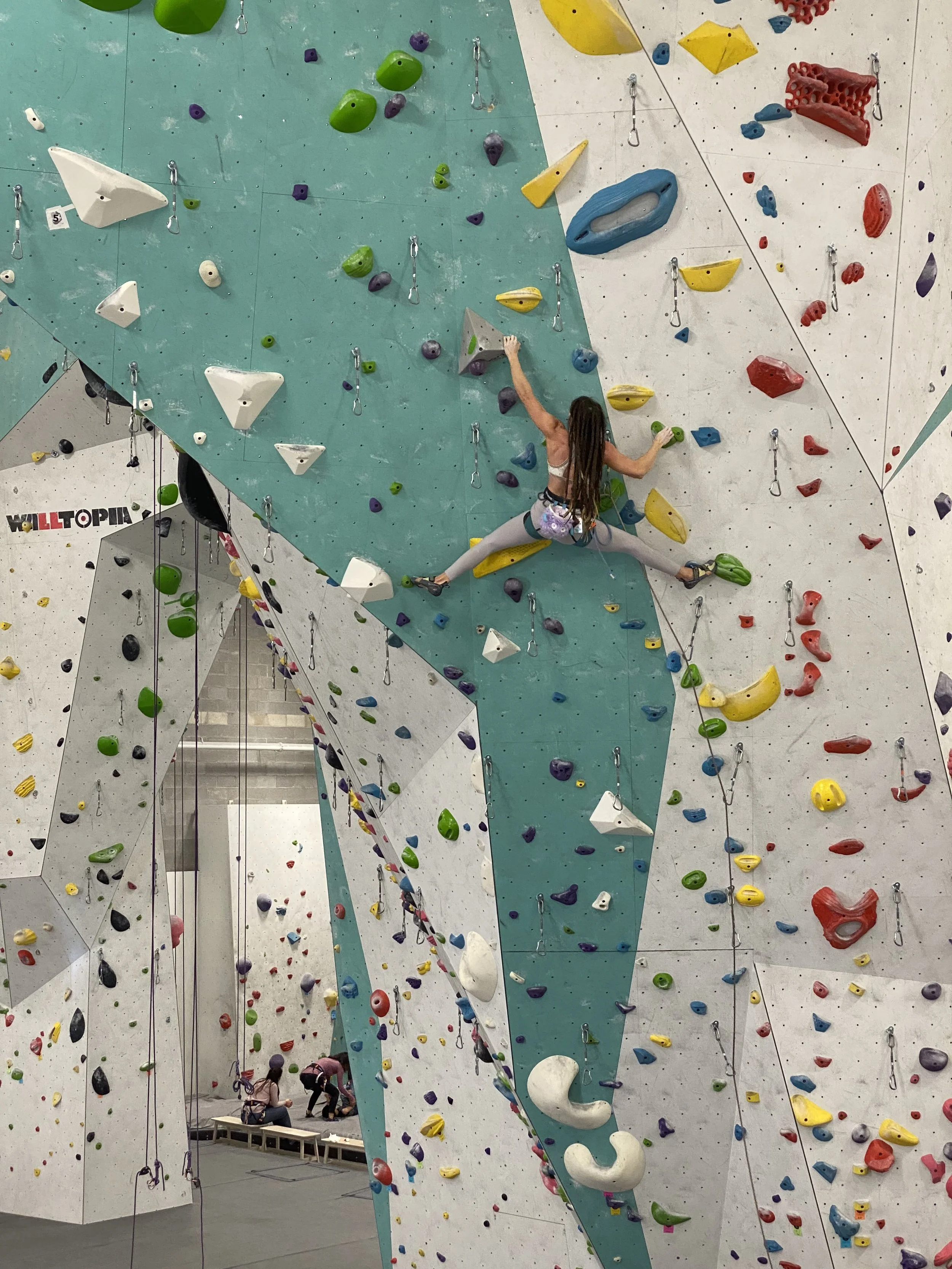
“A lot of the nuances of climbing are hard to teach directly, but they start to sink in naturally when you’re consistently around people who have been doing it longer.”
Amanda: What’s one thing you did during your climbing career that helped you improve faster?
Jamie: There are a few periods in my climbing career where I felt noticeable jumps in my ability, and a lot of them came from being more deeply involved in the sport beyond just showing up to climb.
Two of the biggest were coaching and routesetting, even though those opportunities aren’t necessarily available to everyone. Coaching forced me to become much better at reading movement and understanding how different climbers approach the same problem. You start to recognize that there usually isn’t just one “correct” beta.
Different body types, strengths, mobility, and experience levels all change what works. Helping other people solve movement problems ended up sharpening my own climbing a lot more than I expected.
Routesetting expanded that even further. Setting gave me a much deeper appreciation for intentional movement, flow, difficulty, and how small changes can completely alter a climb. Honestly, though, I think coaching laid the groundwork for becoming a better setter more than the other way around.
The more universally applicable thing, though, was consistently climbing with people who were stronger and more experienced than me. That probably accelerated my progress more than anything else. Being around climbers who move well raises your understanding of what’s possible, and it naturally pushes your technique, mindset, and effort level upward. Even when you can’t do what they’re doing yet, you start absorbing pieces of how they approach climbing.
Amanda: Tell me about a climber you look up to.
Jamie: There are honestly a ton of climbers I admire, but I tend to gravitate more toward watching women’s climbing. The movement is often more technical, creative, and interesting to me, and there are several climbers whose styles or accomplishments I really look up to.
Janja Garnbret is probably the obvious answer in terms of pure dominance. I genuinely think she’s the greatest competition climber ever, regardless of gender category. The level of consistency, composure, and versatility she’s shown across bouldering, lead, and combined formats is unreal. She makes incredibly difficult climbing look almost casual, which is probably the highest compliment you can give a climber.
Brooke Raboutou is another climber I really admire because her range is so impressive. She has this huge repertoire of hard climbs across disciplines, and she manages to balance competition climbing with elite outdoor performance in a way very few people can.
Then there’s Jain Kim, who might be the most graceful climber I’ve ever watched. Her movement is so controlled and efficient that it almost looks choreographed. She’s one of those climbers who reminds you that climbing can be beautiful as much as it is athletic.
And Michaela Kiersch is someone I really respect for continuing to push the ceiling of women’s sport climbing. Her persistence, especially on long-term projects and cutting-edge routes, is incredibly motivating. She represents a side of climbing that’s less about flashy moments and more about grit, patience, and commitment over time.
Amanda: Tell me about a memorable climb.
Jamie: I don’t think anything is quite as memorable as doing something for the first time, especially in climbing where every new experience feels a little bigger than you expect it to.
Early on in my climbing, I took a trip to Colorado with my partner Joey, and we climbed Pear Buttress in Lumpy Ridge. It’s a 5.8, five-ish pitch route with a technical start and a 100 foot finger and hand crack on pitch 3. One thing I definitely was not, and honestly still am not, is a crack climber.
At the time, though, this route felt absolutely massive to me. It was only my second multipitch ever and my first trad multipitch, so everything about it felt intimidating. I remember thinking the route had to secretly be 5.11, even though every local probably considers it a casual afternoon outing. Maybe the grade still reflects when it was first established in the 1960s, or maybe I was just wildly inexperienced. Probably both.
I think I cycled through every emotion possible on that climb, sometimes all within the same pitch. But getting to the top felt incredible in a way that’s hard to replicate. It was one of those experiences where the accomplishment mattered more because I felt genuinely out of my comfort zone the entire time.
It also gave me a renewed appreciation for single-pitch sport climbing and bouldering. Every time I do a big multipitch day, I come back a little more grateful for short approaches, bolts, and being on the ground after one pitch.
Amanda: What frustrates you the most about climbing?
Jamie: One thing that definitely frustrates me about climbing is how seriously people treat grades, especially the expectation that grades should feel perfectly consistent everywhere. The grading debate has existed forever, and it’s never going to be fully solved because climbing is incredibly subjective.
I could set a climb in our gym that we’d call V4, and I can immediately think of outdoor areas where that exact climb would probably get called V0 or V7. Different setters value different styles of movement, different regions develop different grading cultures, and every climber brings a different body type, skill set, and experience level to the wall. There’s just no universal standard the way people sometimes want there to be.
I think grades are useful to a point. They can help you measure progress, choose projects, or roughly understand difficulty. But the problem starts when the grade becomes the entire goal or the main source of validation. If your fulfillment in climbing only comes from chasing a number, I think that’s usually a pretty short road before frustration sets in.
“I think grades are useful to a point. But if your fulfillment in climbing only comes from chasing a number, I think that’s usually a pretty short road before frustration sets in.”
The people who tend to stay in climbing long term are usually the ones who learn to value movement, experiences, community, and personal progression beyond just what number gets attached to the send.
Amanda: What’s something climbing-related that you would have done differently if you could go back in time?
Jamie: Start earlier. That’s really the only thing.
Amanda: What are your climbing goals or vision for the future?
Jamie: As I’m getting older, I think my goals are shifting a little. I still care about improving and climbing hard, but I’m becoming more interested in figuring out what longevity in the sport looks like. I don’t feel like I’m at the point where hard climbing is behind me or anything like that, but I do think the approach probably has to evolve over time.
When you’re younger, you can sometimes get away with just throwing yourself at everything full force. As I’ve climbed longer, I’ve started realizing that recovery, consistency, injury prevention, and being intentional with training matter a lot more than they used to. I’m still figuring out exactly what that balance looks like for me, but honestly, that process has been exciting in its own way.
One of the things I love most about climbing is that it constantly gives you new things to learn about yourself. Right now, I think my “goal” is less about chasing a specific grade and more about finding ways to stay motivated, stay healthy, and keep progressing for a long time. This is partly why I’m training for and participating in an outdoor bouldering competition this fall. The challenge just looks a little different than it did when I first started and I imagine it will continue to evolve.